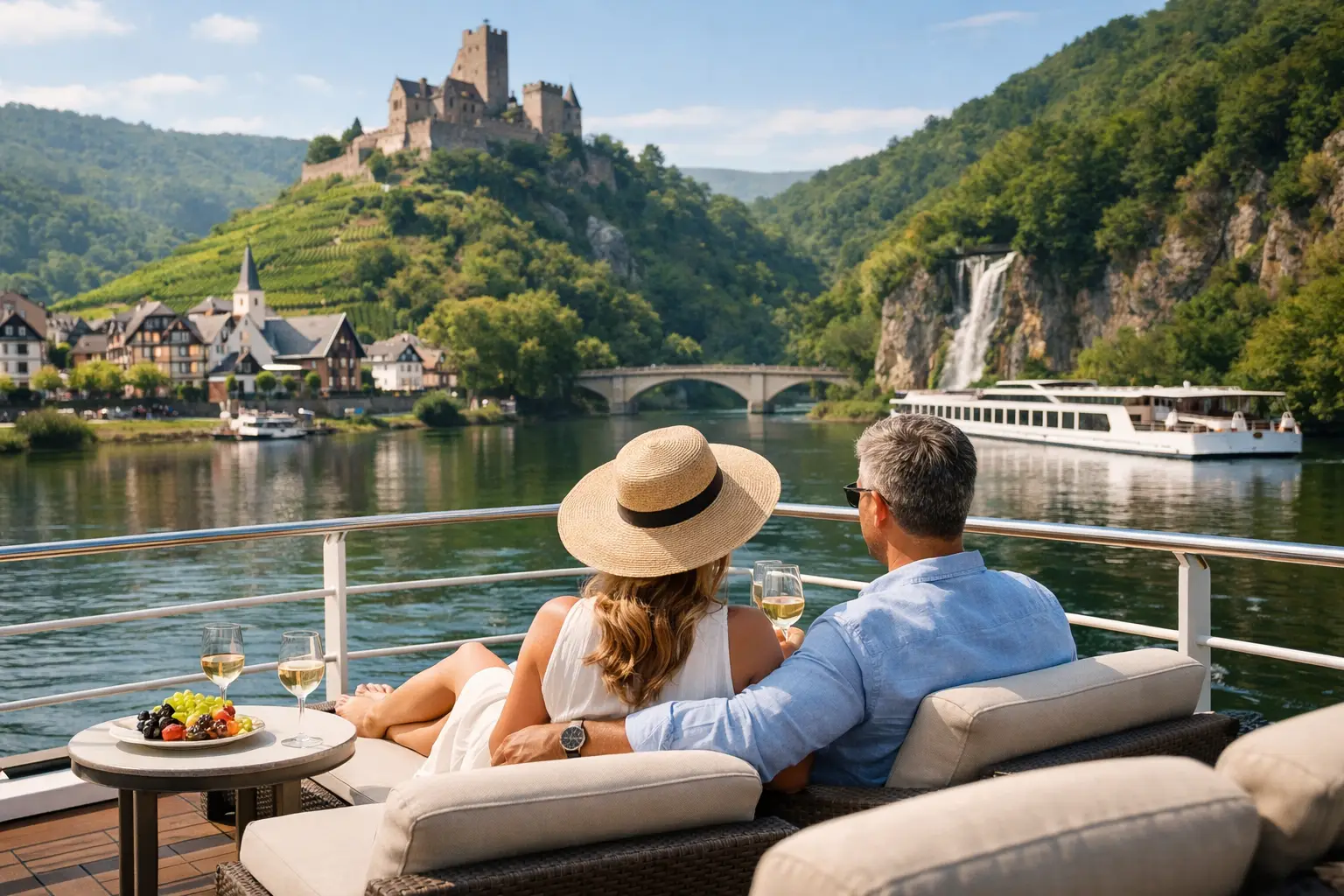
The hidden gems you’ll discover on a luxury river cruise are rarely marked by a grand entrance. They may be a vineyard owner opening a centuries-old cellar after the larger crowds have left, a church organist playing for a handful of guests in a candlelit chapel, or a morning spent walking the cobbled lanes of a village that most visitors pass on the highway. The river itself changes the rhythm of travel. Rather than checking in and out of hotels and rushing between landmarks, you arrive at the heart of a place with time to notice its texture.
For well-traveled guests, that unhurried access is often the real luxury. Europe’s celebrated capitals and landmarks deserve their reputation, of course. Yet the moments that stay with you are frequently found in the smaller towns, family kitchens, historic workshops, and landscapes that reveal themselves between the headline destinations.
The Hidden Gems on a Luxury River Cruise Begin Beyond the Big Ports
A thoughtfully designed river itinerary balances famous cities with less-expected calls. On the Danube, that might mean stepping beyond Vienna and Budapest to spend an afternoon in Dürnstein, Austria, where apricot orchards and baroque rooftops sit beneath the ruins of Richard the Lionheart’s former prison. On the Rhine, the drama is not limited to Cologne or Strasbourg. It is in the castles that appear one by one along the gorge, the half-timbered streets of Rüdesheim, and the small family estates pouring Riesling along the riverbanks.
The Rhône and Saône offer a different kind of intimacy. Burgundy’s wine villages can feel deeply personal when experienced with a local guide who knows which cellar is producing an exceptional vintage and which market vendor makes the region’s most memorable gougères. Along Portugal’s Douro, terraced vineyards rise almost vertically from the water, and an evening at a quinta can offer a far richer understanding of Port than a tasting room in a major city.
These places are not “undiscovered” in any literal sense. They are living communities with long histories and devoted visitors. Their appeal lies in how a luxury river cruise makes room for a more considered encounter, rather than treating them as a brief photo stop.
A More Personal Way Into Local Culture
The most meaningful shore experiences replace broad generalizations with human stories. A guided walk through a medieval town is more memorable when the guide points out the courtyard where her grandmother lived, explains why a particular festival matters to the community, or introduces the baker whose family has worked the same shop for generations.
Culinary traditions with a sense of place
Food is often the most immediate route into a destination’s character. River cruising brings travelers close to regions whose culinary traditions do not always reach American restaurants in their full expression. Think of Alsatian tarte flambée served with a crisp local white wine, a truffle-focused lunch in Provence, Hungarian pastries in a Budapest café, or a farmhouse meal in the Wachau Valley.
The distinction is not simply that the meal is regional. It is the context: tasting cheese made nearby after meeting the producer, learning why a particular grape thrives on one slope but not another, or sharing lunch in a village where the ingredients traveled only a few miles to the table. Small-group and private experiences can make these encounters especially rewarding, allowing time for conversation and flexibility rather than a fixed, crowded program.
Artisans and traditions that endure
Europe’s rivers run through regions shaped by generations of craft. Depending on the itinerary, guests may meet a cooper who makes barrels for local wineries, watch porcelain painters at work, visit a traditional textile workshop, or hear an intimate performance of regional music.
These are not decorative additions to a day ashore. They offer a clearer sense of what has endured in a place, and what is changing. A skilled local host can also help travelers distinguish between an authentic artisan visit and a stop designed primarily for tour buses. That discernment matters, particularly for those who have traveled extensively and value substance over spectacle.
The River Offers Its Own Quiet Revelations
Some of the finest discoveries happen without leaving the ship. A river journey is one of the rare ways to experience Europe as a connected landscape rather than a collection of airports, train stations, and hotel lobbies. From the Sun Deck, you see vineyards give way to stone villages, then forests, farms, abbeys, and industrial towns. The transitions are gradual, and that gradualness teaches you something.
An early morning passage through the Rhine Gorge can make the region’s legends feel surprisingly plausible. Drifting through the Douro Valley at golden hour reveals the immense labor built into every vineyard terrace. On the Mekong, the river is a window into daily life: fishing boats, floating homes, children commuting by water, and markets that operate according to the river’s pulse.
Luxury ships elevate this experience through comfort, attentive service, and well-paced days, but a quieter shipboard moment is not always a lesser one. Sitting with coffee while the landscape changes outside the window can be every bit as powerful as a formal excursion. It gives the traveler space to absorb what they have seen.
When Private Access Makes the Difference
The term “luxury” is sometimes used too broadly in travel. On a river cruise, its most compelling meaning is often access: access to smaller groups, knowledgeable guides, special venues, and time that is protected from logistical friction.
A private after-hours visit to a historic palace, a concert in an intimate salon, or a hosted tasting at an estate normally closed to walk-in visitors can transform a familiar destination. These experiences are never guaranteed on every sailing, and they vary by river line, season, itinerary, and local availability. That is precisely why expert planning is valuable. The right cruise is not necessarily the ship with the largest suite or the longest inclusion list. It is the one whose pace, excursion philosophy, dining style, and guest profile fit the way you want to travel.
For some travelers, a highly curated small-group itinerary will be ideal. Others may prefer a ship that allows more independent time ashore, with private guides arranged in key ports. A couple celebrating an anniversary may value a leisurely day in a wine village over a packed schedule of museum visits. There is no universal best choice, only the itinerary that reflects your interests.
How to Find the Hidden Gems That Matter to You
The most rewarding river cruise begins with a conversation that goes beyond destinations. Do you collect art, cook, study history, enjoy gardens, or seek exceptional wine? Are you energized by active walking days, or do you prefer a gentler pace with time to linger in cafés? Have you already seen the major landmarks and want a more nuanced return to Europe?
Those answers shape the details. A history enthusiast might pair a Danube sailing with several nights in Prague or Vienna and arrange specialist-led visits. Wine lovers may favor the Douro, Rhône, or Moselle, while travelers drawn to landscapes and village life may find the Seine or Rhine especially rewarding. Pre- and post-cruise stays can also turn a fine itinerary into a more complete journey, giving you time to settle into a city before sailing or linger in a region that deserves more than one afternoon.
At Dream Vacations – Matt Boshcka, this is where concierge-level planning has real value: matching the journey to the traveler, then refining the experiences around it. The ship is an elegant home on the water. The true purpose of the journey is what happens beyond the gangway.
A luxury river cruise invites you to trade the checklist for curiosity. Leave room in the itinerary for the unscripted café, the overlooked chapel, the conversation with a local guide, and the view that makes everyone on deck fall quiet. Those are often the moments that become part of your story long after you are home.
Leave a Reply