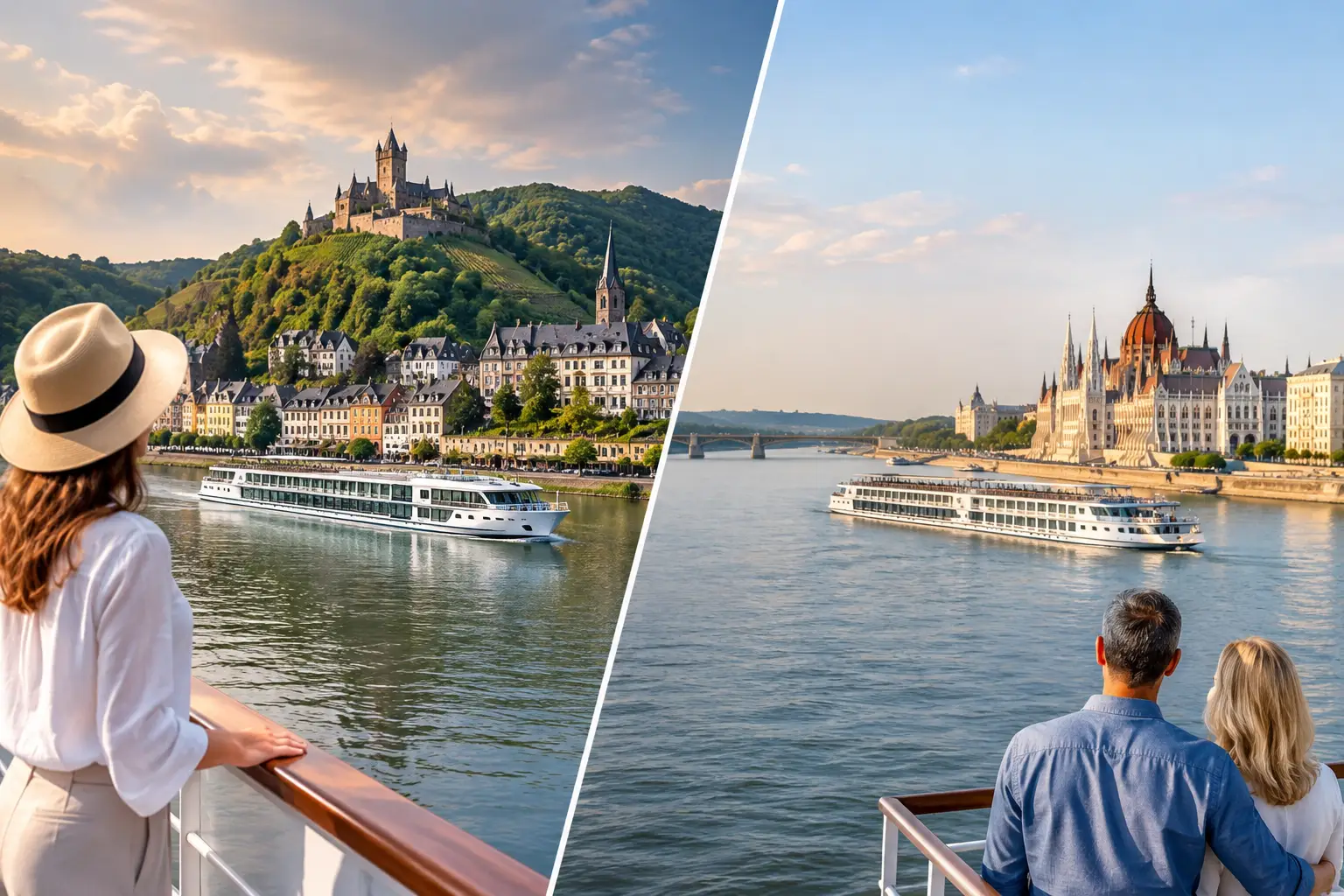
The choice often reveals itself in a single image: a vineyard-cloaked hillside rising above a castle on the Rhine, or a candlelit concert hall in Vienna after an unhurried Danube afternoon. When considering a Rhine vs Danube river cruise: which should you choose?, neither is objectively better. Each offers a distinct expression of Europe – and the right one depends on whether you are drawn more to storybook landscapes and concentrated medieval charm, or grand capitals, layered empires, and a broader sweep of cultures.
For discerning travelers, the decision is less about checking cities off a list and more about choosing the rhythm, atmosphere, and memorable moments that will define the journey.
Rhine vs Danube River Cruise: The Essential Difference
The Rhine is Europe at its most visually immediate. On the classic stretch between Amsterdam and Basel, the scenery seems to arrive continuously: steep vineyard terraces, half-timbered towns, Gothic spires, and hilltop fortresses appearing around nearly every bend. It is an intimate river of legends, wine traditions, and remarkably walkable ports.
The Danube feels more expansive in both geography and cultural scope. A typical itinerary between Budapest and Vienna, or Budapest and Nuremberg, moves through the former Habsburg world and beyond. One day may bring imperial architecture and a private music performance; the next may lead to a hillside abbey, a Slovakian capital, or a village shaped by centuries of Central European tradition.
Choose the Rhine for concentrated scenic drama and a strong sense of medieval Europe. Choose the Danube for imperial grandeur, cultural variety, and an itinerary that can feel more cosmopolitan.
Choose the Rhine for Castles, Wine, and Storybook Scenery
The Rhine is particularly rewarding for travelers who want the landscape to be part of the experience, not simply the space between ports. The Middle Rhine Gorge, a UNESCO-recognized cultural landscape, is the river’s defining passage. Ships sail past a remarkable succession of castles, watchtowers, rocky cliffs, and small wine villages, often with commentary that brings the region’s history to life.
Cologne offers soaring Gothic architecture and a lively riverside setting. Strasbourg pairs French refinement with Germanic character, its canals and timbered houses lending the city an almost cinematic appeal. Rüdesheim, Koblenz, Heidelberg, and the Alsace wine villages each offer a different lens on the region’s heritage.
This is also an excellent choice for food and wine enthusiasts. Tastings in family-owned cellars, regional Rieslings, Alsatian cuisine, and market visits can be woven naturally into a Rhine itinerary. The experience is especially satisfying for travelers who appreciate the pleasure of lingering over a local specialty after a guided walk through a compact historic town.
The trade-off is that the Rhine’s core routes are culturally more concentrated. You will encounter the interplay of Germany, France, Switzerland, and the Netherlands, but the journey does not provide the same eastward progression of languages, histories, and architectural styles found on longer Danube routes.
The Rhine is best for travelers who value
A Rhine sailing tends to suit couples who picture themselves enjoying castle views from a suite balcony, strolling cobbled lanes without a long transfer, and discovering regional wine traditions in depth. It is also a natural choice for a first European river cruise because the ports are accessible, the scenery is immediate, and the route delivers a particularly polished balance of relaxation and discovery.
Christmas market sailings are another Rhine specialty. Cologne, Rüdesheim, Strasbourg, and other historic towns become deeply atmospheric in Advent, with illuminated squares, mulled wine, artisan stalls, and traditional seasonal foods.
Choose the Danube for Imperial Cities and Cultural Range
The Danube is the more compelling choice for travelers energized by the contrast between great cities and quieter riverside towns. Vienna, Budapest, and Bratislava form the heart of many popular itineraries, and each offers a profoundly different experience.
Vienna is graceful and intellectual, filled with imperial residences, café culture, art collections, and music. Budapest is dramatic, divided by the Danube itself and crowned by landmarks that glow beautifully after dark. Bratislava, smaller and more understated, invites a slower exploration of its old town and its position at the crossroads of Central Europe.
Beyond these celebrated capitals, the Danube can lead to the Wachau Valley in Austria, where apricot orchards, monasteries, and vineyards shape a gentler pastoral scene. Longer sailings may continue through Hungary, Croatia, Serbia, Bulgaria, and Romania, introducing a more complex and less familiar Europe. That progression can be extraordinarily rewarding for well-traveled guests who want to look beyond the continent’s most familiar highlights.
The Danube is less consistently castle-lined than the Rhine, but its rewards are different. The river frames grand urban skylines, baroque abbeys, concert traditions, and a rich mosaic of national identities. It is a journey for travelers who enjoy context – how empires rose and fell, how borders shifted, and how culture evolves from one riverbank to the next.
The Danube is best for travelers who value
A Danube cruise is ideal if you would rather spend a morning in Vienna’s historic center than photograph another castle from the sun deck. It suits lovers of classical music, art, architecture, culinary history, and the elegant ritual of European city life. It also offers a particularly appealing option for multigenerational travel when different interests need to be accommodated: one guest can visit a museum while another enjoys a market, a food tour, or a relaxed café stop.
For travelers who have already explored Western Europe extensively, a longer Danube itinerary can provide the sense of discovery that makes a journey feel genuinely fresh.
Consider the Pace, Ports, and Daily Experience
Both rivers are well suited to the pleasures of luxury river cruising: unpack once, wake in a new setting, and return to a thoughtfully designed ship after a day ashore. Yet their daily rhythms differ.
The Rhine’s ports are often close together, which creates a lively cadence of short sailings and frequent opportunities to step ashore. Many towns are easily explored on foot, and the scenery during daytime cruising can be exceptional. This makes the Rhine appealing for travelers who want a full schedule without feeling that they are constantly in transit.
Danube itineraries often feature longer stretches between ports, particularly on itineraries that venture east of Budapest. The sailing time can be wonderfully restorative, but the experience may involve more panoramic cruising and, depending on the route, occasional longer drives to certain landmarks. In exchange, the cultural range becomes far greater.
Shore experience matters as much as itinerary. A standard included walking tour is only one way to encounter a destination. Private guides, behind-the-scenes access, active options, culinary experiences, and carefully paced independent time can transform the feel of either river. This is where a personalized approach is valuable: the same route can feel entirely different for an art collector, a history enthusiast, a devoted gourmand, or a couple celebrating a milestone.
When Should You Sail?
Spring brings fresh green landscapes, blooming gardens, and generally cooler temperatures. It is lovely for travelers who prefer fewer crowds and do not mind variable weather. Summer offers long daylight hours and vibrant energy in the cities, though popular ports can be busier and temperatures warmer.
September and October are often exceptional on both rivers. The vineyards are active, the light is softer, and the weather is often comfortable for walking. The Rhine is especially appealing during harvest season, while the Danube’s capitals take on a cultured, autumnal charm.
December is for travelers who want Europe at its most festive. Rhine Christmas markets are legendary, while Danube sailings offer memorable celebrations in Vienna, Budapest, and smaller Austrian towns. These voyages are magical, though daylight is limited and weather can be quite cold.
A Few Deciding Questions
If you are still choosing between the Rhine and Danube, consider what you would be disappointed to miss. Is it the thrill of seeing castles drift by from your balcony, a leisurely tasting in a vineyard village, and the compact charm of Strasbourg or Cologne? The Rhine is likely your river.
Or would you rather attend a concert in Vienna, admire Budapest illuminated at night, and trace the cultural legacy of Central Europe across several countries? The Danube is likely the more meaningful choice.
It is also worth considering how you want to extend your journey. The Rhine pairs beautifully with time in Amsterdam, Paris, Lucerne, or the Swiss Alps. At Dream Vacations – Matt Boshcka, we recommend pre- or post-cruise stays in Prague, Vienna, Budapest, or even a deeper land journey into the Balkans. A few well-chosen nights on land can give the entire experience more depth and ease.
The best river cruise is not the one with the longest list of included ports. It is the one that reflects the stories you want to bring home. Whether that means toasting a fine Riesling beneath a Rhine castle or hearing Strauss in Vienna after sunset, a thoughtfully curated journey ensures the river becomes more than a route – it becomes part of your own travel story.
Leave a Reply