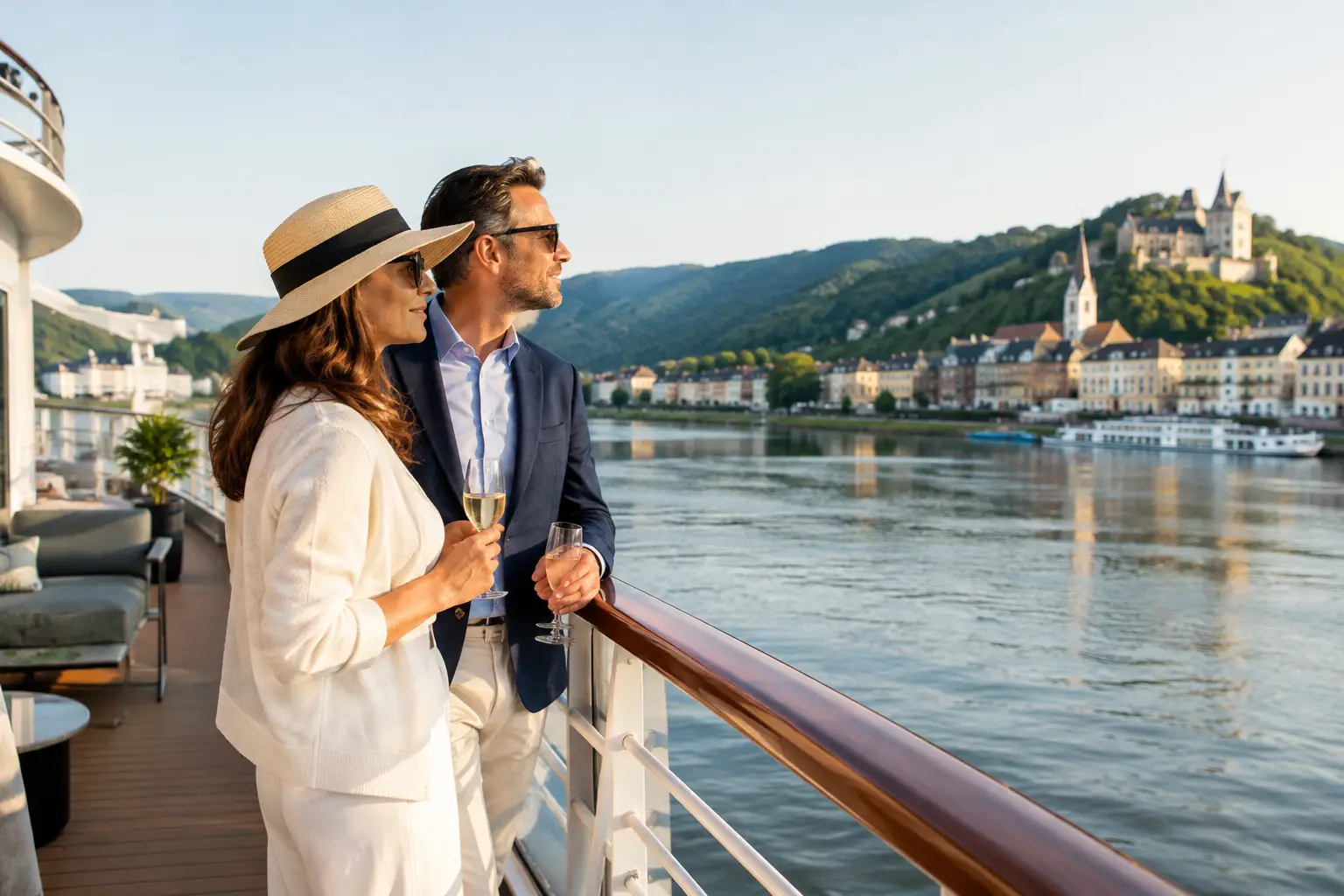
A private evening concert in a Viennese palace. A guide who knows the family behind the vineyard where you are tasting wine. A morning walk through a medieval town before the day-trippers arrive. These are the moments behind why luxury travelers are choosing river cruises over ocean cruises. The appeal is not simply a smaller ship or a more scenic route. It is the feeling that the journey belongs to the destination, rather than being a floating resort that happens to stop there.
For well-traveled guests, luxury is increasingly measured in time, access, authenticity, and ease. River cruising delivers all four with an especially graceful rhythm. You unpack once, wake up in the heart of a new city or village, and spend your days connected to the landscapes, cultures, and flavors that brought you to Europe, Southeast Asia, Egypt, or Colombia in the first place.
Why luxury travelers are choosing river cruises over ocean cruises
Ocean cruises remain an excellent choice for certain journeys, particularly when the itinerary calls for remote islands, coastal capitals, or days at sea. But for travelers who have already seen the major highlights and want a more intimate, destination-focused experience, a river cruise often feels like a meaningful evolution.
The most immediate difference is scale. Even premium ocean ships can carry thousands of guests, while luxury river vessels typically welcome a far smaller number. That changes the atmosphere aboard. Public spaces feel calm rather than crowded, service becomes more personal, and fellow guests are easier to know. There is room for a lingering conversation over a regional wine, not a constant need to reserve, queue, or navigate a vast ship.
Just as important, river ships travel through the landscape rather than alongside it. From the sun deck, you may watch vineyard terraces rise above the Danube, castles appear around a bend in the Rhine, or see everyday life unfold along the banks of the Rhône. The route itself becomes part of the experience.
The destination is not a port call
On many ocean itineraries, a port day can be brief. A ship may dock some distance from the city, and the experience can be shaped by traffic, tender operations, or a fixed all-aboard time. River cruising is designed differently. Ships frequently berth within walking distance of historic centers, allowing guests to step ashore and begin exploring almost immediately.
That access gives a day a different texture. Instead of sampling a destination from a distance, travelers can enjoy an unhurried market visit, return to the ship for lunch, then head back out for an afternoon museum or café. In many towns, the ship remains docked into the evening, making it possible to experience a concert, a wine bar, or the quiet beauty of illuminated old streets.
Luxury river cruise lines also tend to build their shore programs around meaningful local connections. One guest may prefer a guided art history walk through Amsterdam, while another would rather cycle through the Dutch countryside. In Bordeaux, a serious wine enthusiast may want a private château visit; in Provence, a culinary-minded traveler may be drawn to the market stalls, olive groves, and family-run kitchens that define the region.
The strongest river cruise experience leaves room for personal interests. A thoughtfully planned journey does not require every guest to see a destination in exactly the same way.
A more considered pace
Luxury travelers often tell us they want to see deeply without the fatigue of constant packing, airport transfers, and hotel changes. River cruising answers that desire remarkably well. Your suite travels with you while the world outside changes each day.
There is also a gentler cadence to a river itinerary. Mornings might begin with an expert-led walk, afternoons with time to explore independently, and evenings with local entertainment or relaxed conversation on board. The pace can be active, but it is rarely frantic.
For couples celebrating retirement, a milestone birthday, or a long-awaited second honeymoon, this balance is particularly appealing. The journey feels full without becoming over-programmed. It creates space for discovery, as well as time to savor what has already been discovered.
Intimacy without sacrificing comfort
Small-scale does not mean small-minded. The finest river ships offer elegantly designed suites, thoughtful dining, attentive staff, and an atmosphere that is polished without being formal. The luxury is often quieter than on a large ocean vessel. It is found in the details: a preferred cocktail remembered after the first evening, fresh flowers in your suite, a knowledgeable host who anticipates the next step, or a chef who brings regional ingredients into the menu with genuine care.
Dining is a particularly revealing example. Rather than an overwhelming choice of restaurants designed to serve a massive population, river cruises typically focus on quality, regional inspiration, and flexibility. A dinner paired with Austrian wines or a lunch featuring French cheeses can deepen your sense of place in a way that feels natural, not staged.
This intimacy extends to service. On a smaller vessel, the crew has the opportunity to recognize individual preferences and respond quickly. For travelers accustomed to high-touch hospitality, that familiarity can make the entire journey feel more relaxed. There is less effort required to get the experience you want.
Cultural immersion has become the new status symbol
There was a time when the biggest suite, the grandest ship, or the most elaborate onboard spectacle defined cruise luxury. Those elements still have their place. Yet many discerning travelers now place greater value on experiences that cannot be replicated at home.
A cooking lesson with a local chef in Lyon, an after-hours visit to a landmark, a conversation with a winemaker in the Douro Valley, or a quiet sunrise over the temples along the Mekong carries a different kind of value. These moments become stories – the kind shared at family dinners long after a journey ends.
River cruising lends itself to this form of luxury because its geography is inherently cultural. Europe’s great rivers connect not only capitals, but also villages, vineyards, abbeys, battlefields, and centuries of art and architecture. The Nile reveals ancient civilization in sequence. The Mekong offers a window into the daily life, craftsmanship, and spiritual traditions of Vietnam and Cambodia.
For travelers who have checked famous destinations off a list, the river offers a more layered way to return. Paris may be familiar, but arriving through Normandy or Burgundy changes the perspective. Budapest is compelling on its own, yet seeing it after a journey through the Wachau Valley and Bratislava gives it greater context.
The trade-offs deserve an honest look
River cruising is not automatically the right choice for every luxury traveler. Ships are compact by design, which means fewer restaurants, smaller fitness areas, and limited entertainment compared with large ocean vessels. Cabins and suites can be beautifully appointed, but their footprint is generally more modest than a top-tier ocean suite.
The experience is also itinerary dependent. Water levels, locks, and occasional weather events can require adjustments, particularly on European rivers. A trusted travel advisor can help you choose the right season, river, ship, and itinerary, while setting realistic expectations about what may change.
Ocean cruising may be better for multigenerational groups seeking extensive onboard activities, travelers who love sea days, or guests drawn to destinations that are best reached by water, such as the Galápagos, Alaska, or the Mediterranean’s islands. Small-ship ocean cruising can also provide much of the intimacy river travelers value, with the added reach of coastal and expedition-style routes.
The question is not which type of cruise is objectively superior. It is which journey best matches the way you want to travel now.
Choosing the river that fits your story
The Danube may suit travelers interested in imperial history, classical music, and Central European cities. The Rhône and Saône invite food and wine lovers into the heart of France. The Rhine combines storybook scenery with culturally rich cities, while the Douro offers a more relaxed immersion in Portugal’s dramatic wine country.
Beyond Europe, the Nile is extraordinary for travelers captivated by ancient history and private-guided exploration. The Mekong offers rich contrasts, from bustling cities to rural villages and sacred temples. Each river has its own personality, and each can be enhanced by a carefully selected pre- or post-cruise stay.
At Dream Vacations – Matt Boshcka, the planning begins with the experiences you hope to remember, not a generic ship recommendation. A river cruise can become the centerpiece of a larger journey: a few nights in Paris before sailing through Normandy, a private stay in Lisbon after the Douro, or time in Prague before embarking on the Danube.
The most rewarding river cruise is not necessarily the one with the fullest itinerary. It is the one that gives you a genuine sense of place, with enough thoughtful space to make the journey your own. Start with the story you want to bring home, and let the right river lead you there.
Leave a Reply