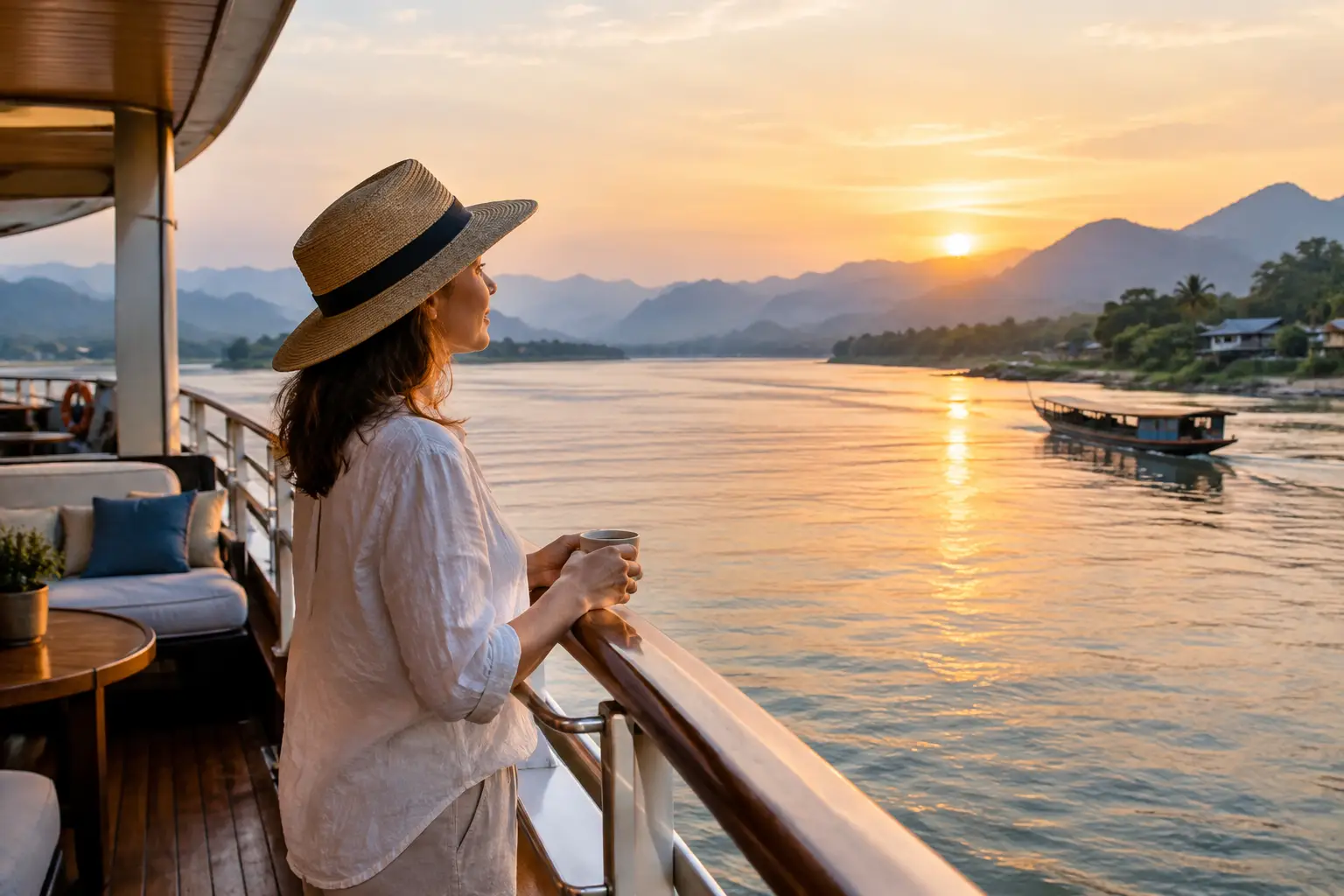
The morning begins with a sampan gliding through the quiet canals of the Mekong Delta. A fisherman checks his nets beneath coconut palms. By afternoon, you may be walking through a Cambodian village, welcomed into a family home or receiving a blessing at a centuries-old pagoda. Mekong river cruises offer this rare sense of proximity: the ability to experience Vietnam and Cambodia not as a sequence of attractions, but as living, deeply layered places.
For travelers who have already seen much of the world, the Mekong is compelling precisely because it resists a hurried approach. It rewards curiosity, conversation, and time. A well-chosen sailing combines the comforts of an intimate river vessel with meaningful access to local life, ancient history, remarkable cuisine, and landscapes that continue to shape the rhythm of Southeast Asia.
Why Mekong River Cruises Feel So Personal
The Mekong is not a river of grand European capitals rising just beyond the dock. Its appeal is more elemental. The journey moves through broad waterways, lush delta channels, floating villages, rice fields, small markets, and rural communities where daily life unfolds close to the water.
That setting creates a different kind of luxury. Certainly, the finest ships provide gracious service, thoughtfully designed suites, excellent regional cuisine, and calm places to retreat after a day ashore. Yet the lasting impression often comes from moments that cannot be replicated in a hotel: tasting tropical fruit in a local orchard, watching a monk pass quietly through a temple courtyard, or hearing a guide explain the resilience of a community shaped by the river’s seasonal changes.
The best itineraries balance these experiences with context. Vietnam and Cambodia have endured colonial rule, war, extraordinary cultural continuity, and rapid modern change. Seeing the region with an accomplished local guide brings depth to what might otherwise be a beautiful but surface-level journey. A visit to Phnom Penh, for example, can encompass the grandeur of the Royal Palace as well as the difficult but essential history of the Khmer Rouge era. The experience should be handled with sensitivity, never reduced to a checkbox.
The Classic Mekong River Cruises Route
Most luxury Mekong river cruises operate between Ho Chi Minh City, Vietnam, and Siem Reap, Cambodia, usually over seven nights. Sailings may travel in either direction, and the route typically includes the Mekong Delta, the Cambodian border region, Phnom Penh, and smaller river communities before or after the cruise portion.
The itinerary is especially well suited to travelers who appreciate a measured pace without sacrificing variety. In Vietnam, the delta offers a vivid introduction to life on the water. Narrow tributaries are often explored by small boat, allowing access to areas the main vessel cannot reach. Excursions may include a family-run workshop, a market visit, a bicycle ride along quiet lanes, or a cooking demonstration that reveals the herbs, fruits, and spices central to southern Vietnamese cuisine.
Cambodia brings a notable shift in atmosphere. The river widens, villages feel more rural, and Buddhist traditions become more visible. Phnom Penh offers urban energy and historical perspective, while smaller stops may provide opportunities to meet artisans, visit monasteries, or observe the enduring importance of the river to farming and fishing families.
For many travelers, the natural companion to a Mekong cruise is time in Siem Reap. Angkor is not a single temple but an immense archaeological landscape, and it deserves more than a rushed day. Private guiding can transform the experience, whether your interests lean toward architecture, photography, spirituality, or simply finding quieter moments at sites beyond Angkor Wat.
Why a Pre- or Post-Cruise Stay Matters
A river cruise provides an elegant framework, but it should rarely be the entire journey. Ho Chi Minh City merits at least two nights for its markets, food culture, French colonial architecture, and powerful historical sites. Siem Reap deserves the same consideration, particularly for travelers who want to explore Angkor at an unhurried pace.
Adding a few days also creates breathing room around international flights. Rather than stepping off a long-haul journey directly onto a ship schedule, you can arrive rested, settle into a fine hotel, and begin with a private introduction to the city. This is one of the simplest ways to make the overall experience feel more relaxed and more personal.
Choosing the Right Ship and Style of Sailing
Not all Mekong vessels deliver the same experience. Some are intimate boutique ships with fewer than 30 suites, while others are larger and offer a broader range of public spaces. Neither approach is automatically better. The right choice depends on how you travel.
A smaller vessel often feels more like a private club, with a familiar crew, flexible service, and a relaxed social atmosphere among a limited number of guests. Larger ships can offer more suite categories, additional dining options, and more expansive lounges. Travelers who value privacy may favor a ship with private balconies and generous suite dimensions, though it is worth remembering that the region’s most memorable views often happen on the open deck or from a small excursion boat close to shore.
Look beyond polished interiors. Ask about the ratio of guests to guides, the size of excursion groups, the quality of the local guiding team, and whether activities can be adapted for different mobility levels. A ship may be beautifully designed, but the quality of its shore program determines much of the journey.
Cuisine also varies meaningfully. The most rewarding ships treat meals as part of the cultural experience, with Vietnamese and Khmer dishes prepared alongside familiar Western choices. For guests with dietary needs, advance planning is essential. A knowledgeable travel advisor can communicate requirements before departure and help identify the operator best equipped to handle them well.
When to Go: Weather, Water Levels, and Trade-Offs
The most popular time for Mekong sailings is generally November through February, when temperatures are more comfortable and rainfall is limited. This is an appealing period for travelers who prefer drier conditions, particularly when pairing the cruise with extensive touring in Cambodia and Vietnam.
March through May brings hotter weather, sometimes intensely so in Cambodia. The advantage is fewer visitors at major sites and, occasionally, a more tranquil feeling on land. Travelers who tolerate heat well may find this a worthwhile trade-off, especially with carefully timed morning excursions and restorative afternoons aboard ship.
The green season, roughly June through October, introduces higher humidity and periods of rain, but it also brings vivid landscapes and dramatic skies. Rainfall does not necessarily mean all-day storms, and water levels can support access to certain channels and floating communities. However, conditions can affect routing and excursion logistics. Flexibility is part of traveling well in this region.
Water levels deserve special attention. The Mekong is a working river governed by nature, and itineraries can occasionally change due to unusually high or low water. Exceptional cruise operators have contingency plans and communicate clearly, but no advisor should promise that every stop will unfold exactly as printed. Travelers who approach the journey with curiosity rather than rigid expectations are often rewarded most.
The Experiences Worth Personalizing
A thoughtfully designed Mekong journey should reflect your interests before you ever board the ship. For food lovers, that may mean a private market tour and a chef-led meal in Ho Chi Minh City. For history-minded travelers, it could include a specialist guide in Phnom Penh and additional time at Angkor’s lesser-visited temples. For those celebrating an anniversary, a suite with private outdoor space, a special dinner, and a beautifully paced land itinerary can make the trip feel distinctly your own.
Mobility is another important consideration. River cruising is gentler than changing hotels every few nights, but excursions can involve uneven paths, steps into small boats, warm weather, and active walking at temples. There are often gentler alternatives, but they should be arranged with honesty and care. The goal is not to see every site. It is to be present for the experiences that matter most to you.
At Dream Vacations – Matt Boshcka, planning begins with those preferences rather than a prepackaged itinerary. The right sailing is only one piece of a larger journey that may include exceptional hotels, private guides, carefully selected dining, and the confidence of knowing that details have been anticipated.
A Journey That Stays With You
The Mekong is best experienced without the pressure to collect landmarks. Leave room for the unexpected conversation, the early-morning light over the river, and the quiet perspective that arrives when travel slows to the pace of the water. With the right ship, the right guides, and time to experience both Vietnam and Cambodia beyond the cruise, this journey becomes far more than a beautiful passage between destinations. It becomes a story with texture, humanity, and lasting meaning.
Leave a Reply