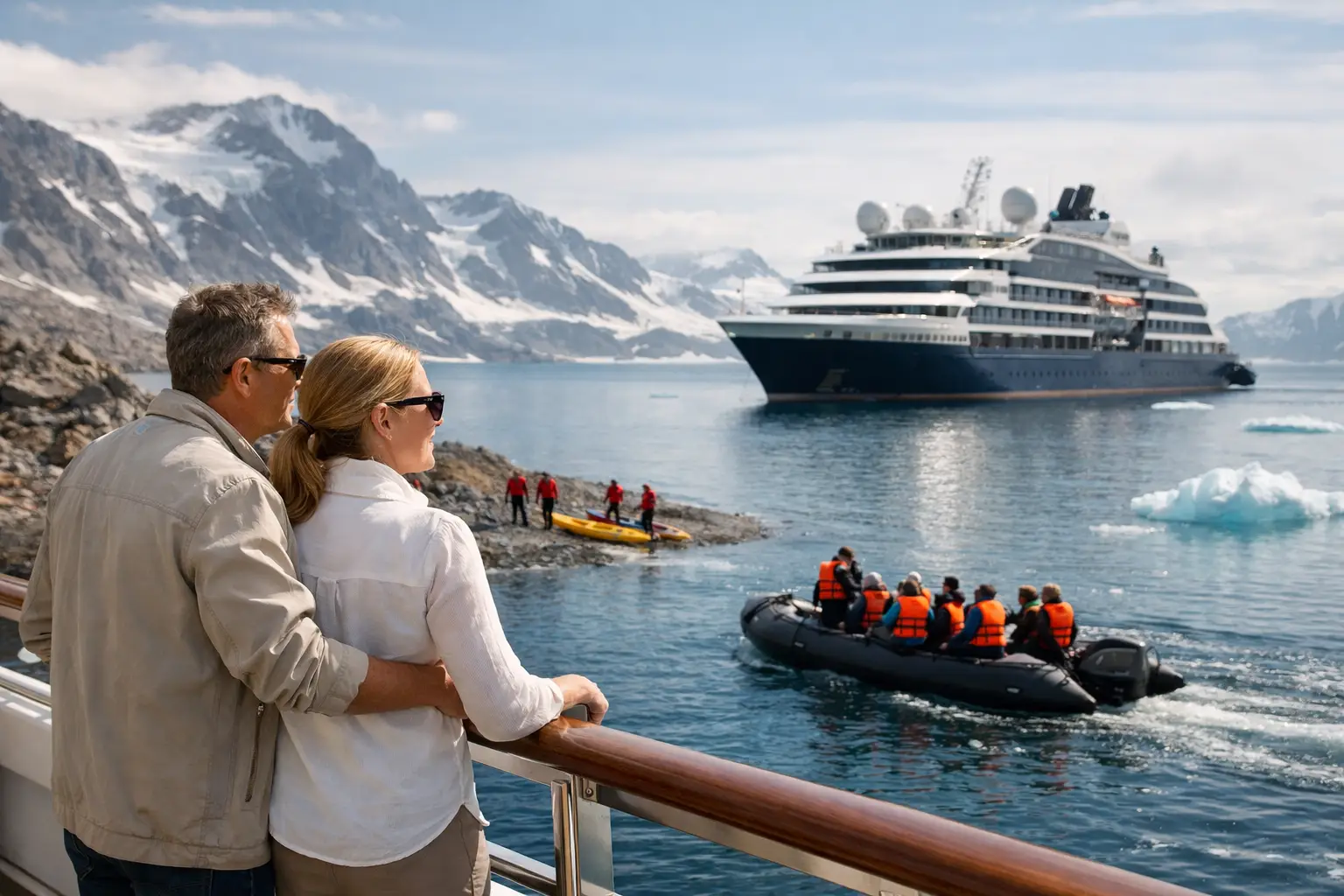
The first time a penguin porpoises alongside a Zodiac in Antarctica, or a polar bear appears as a small cream-colored shape on an Arctic ice ridge, the distinction becomes clear: this is not a conventional cruise with a few scenic stops. Luxury expedition cruises explained simply are journeys designed to bring travelers meaningfully closer to the world’s most remote places, with the comfort, expertise, and flexibility to appreciate them fully.
For well-traveled guests, their appeal is not only the rarity of the destinations. It is the quality of access. A small expedition vessel can anchor near a glacier face, land on a wild beach, or position guests for a morning of kayaking among icebergs – then welcome them back to an elegant suite, a warm shower, thoughtful cuisine, and a briefing that makes sense of everything they have just seen.
What Makes a Luxury Expedition Cruise Different?
An expedition cruise combines purposeful exploration with a small-ship voyage. The ship is not merely transportation or a floating resort. It is a highly capable base for daily discovery, carrying guests into regions where roads, hotels, and large vessels cannot go easily.
The expedition element is led by a team of naturalists, historians, marine biologists, photographers, geologists, and destination specialists. They interpret what you are seeing in real time, whether that is the behavior of humpback whales in Alaska, the geology of the Galápagos, or the human history of Greenland’s isolated settlements. Their expertise changes the experience from observing a remarkable landscape to understanding its story.
Luxury elevates the time between those moments and removes much of the friction around them. Accommodations are refined rather than merely functional. Service is personal. Dining is carefully prepared, often with excellent regional ingredients and considered wine selections. Many ships offer spa facilities, fitness spaces, inviting lounges, and suites with private balconies. On the most elevated vessels, there may also be butler service, a sophisticated onboard wine program, and quietly attentive crew members who know how you take your coffee before your first early-morning landing.
This does not mean expedition ships are identical to five-star hotels on land. Space can be more limited, and certain routes are deliberately adventurous. The luxury lies in exceptional guiding, superb operations, considered design, and the confidence that the details are being handled well in an environment where logistics matter.
Luxury Expedition Cruises Explained: The Daily Rhythm
No two days follow a fixed script. That is one of the greatest strengths of expedition travel. Weather, wildlife, sea conditions, and local opportunities shape the itinerary. A captain may alter course to follow a pod of orcas. An expedition leader may rearrange a landing when unusual bird activity is spotted nearby. In polar regions, ice conditions can determine where the ship goes next.
A typical day may begin with coffee and a wake-up call for an early wildlife sighting. After breakfast, guests board sturdy Zodiac boats for a shore landing, a cruise along dramatic cliffs, or close observation of seals resting on ice. Depending on the destination and ship, there may be opportunities to kayak, snowshoe, hike, snorkel, paddleboard, or join a guided walk ashore.
Afternoons might include a second landing or time on deck with the expedition team. Evenings often bring a recap of the day, a talk about tomorrow’s plans, and dinner with fellow travelers who share a genuine curiosity about the world. The atmosphere is usually polished but relaxed. Guests might return from a muddy trail, change for dinner, and find themselves discussing wildlife photography with a scientist over a fine glass of wine.
Flexibility is central, but it should not be mistaken for disorder. The strongest expedition teams are exceptionally organized. They make quick, informed decisions behind the scenes so guests can be present in the experience rather than concerned with its complexity.
Where These Voyages Go Best
Antarctica remains the defining destination for many travelers. Its scale is difficult to prepare for: sculpted icebergs, vast mountain ranges, colonies of penguins, and a silence that feels almost physical. Most first-time visitors sail the Antarctic Peninsula, while longer and more ambitious voyages may include South Georgia and the Falkland Islands. These extended itineraries offer astonishing wildlife and history, but require more sea days and a greater investment of time.
The Arctic offers a very different kind of polar experience. In Svalbard, Greenland, and the Canadian Arctic, encounters can include polar bears, walrus, musk oxen, glaciers, and resilient communities shaped by the far north. Arctic itineraries often place a stronger emphasis on Indigenous cultures and human life in extreme environments.
The Galápagos is ideal for travelers who want extraordinary wildlife with a more accessible, active pace. Here, close encounters with sea lions, giant tortoises, blue-footed boobies, and marine iguanas unfold in a compact archipelago. Itineraries are usually shorter than polar voyages, making them especially attractive when paired with time in Ecuador or Peru.
Alaska, the Kimberley coast of Australia, the Pacific Northwest, the Amazon, Indonesia, Japan, and the coastal regions of Africa also reward travelers who want immersive small-ship access. The best destination depends less on which place is considered most dramatic and more on the experience you want to bring home: polar wilderness, wildlife photography, ancient culture, active exploration, or a blend of all four.
Choosing the Right Ship Matters More Than Many Travelers Expect
Ships differ significantly in size, style, capability, and guest experience. Smaller vessels may offer a more intimate atmosphere and can sometimes reach places larger expedition ships cannot. Larger luxury expedition ships can provide more suite categories, dining choices, lecture spaces, and wellness amenities. Neither is automatically better.
For travelers who value a quiet, highly personal environment, a ship with fewer guests may be the right choice. Those who appreciate more onboard amenities or want a wider selection of excursions may prefer a somewhat larger vessel. In Antarctica, ship size can also affect landing logistics, so the number of guests is a practical consideration, not just a matter of ambiance.
Look beyond photographs of suites. Ask about the caliber and size of the expedition team, the number of Zodiacs available, the ratio of guides to guests, activity options, and whether excursions are included. Also consider the ship’s stabilization technology and ice classification for polar voyages. Comfort at sea matters, particularly for travelers crossing the Drake Passage or sailing exposed Arctic waters.
The itinerary deserves equal scrutiny
A published itinerary should be viewed as a thoughtful framework, not a guarantee. That is normal in remote travel. Still, the route reveals much about the experience. A voyage with more days in the destination generally provides more opportunities for landings and wildlife encounters than one with a longer transit or an ambitious list of ports.
Consider pacing as well. Some guests want a daily physical challenge and every possible kayaking or hiking opportunity. Others prefer gentle walks, Zodiac cruising, photography, and time to absorb each setting. The ideal journey honors your energy level without asking you to compromise on the depth of the experience.
What Is Usually Included – and What May Not Be
Luxury expedition cruises are often more inclusive than traditional ocean cruises. Accommodations, dining, expedition activities, lectures, transfers within the cruise program, and use of specialized equipment are commonly included. On polar sailings, insulated boots and expedition parkas are frequently provided.
However, inclusion levels vary by cruise line. International flights, pre- and post-cruise hotel stays, premium beverages, spa treatments, gratuities, travel insurance, and certain specialty activities may be additional. Charter flights to embarkation points in remote regions can be included on some programs and separate on others.
This is where careful planning has real value. The least expensive fare is not always the most favorable overall investment once required hotels, transfers, flights, and activity costs are considered. More importantly, an itinerary should be designed around the journey before and after the ship. A few unhurried days in Buenos Aires before Antarctica, a private cultural experience in Quito before the Galápagos, or a carefully chosen lodge stay after an African coastal expedition can give the voyage a more complete sense of place.
Who Will Love This Style of Travel?
Luxury expedition cruising is well suited to travelers who are curious, adaptable, and interested in being active participants rather than passive spectators. You do not need to be an elite hiker or an experienced sailor. You do need to be comfortable with early starts, changing plans, uneven terrain, and the possibility that nature will choose the day’s highlight.
It may be less satisfying for guests whose highest priority is predictable port calls, extensive nightlife, casino entertainment, or multiple formal evenings. Expedition travel exchanges those familiar cruise features for something rarer: the chance to stand quietly on a remote shore with a small group of fellow travelers and feel that you have arrived somewhere truly beyond the ordinary.
For destinations as complex and consequential as Antarctica, the Arctic, or the Galápagos, a knowledgeable advisor can help align ship, season, route, cabin, activity level, and pre- or post-cruise arrangements with your personal travel style. At Dream Vacations – Matt Boshcka, that process begins with the experiences you hope to have, not a catalog of ships.
The right expedition voyage should leave room for wonder. Choose the one that gives you time not only to see the ice, wildlife, and distant horizons, but to linger long enough for those moments to become part of your own story.
Leave a Reply