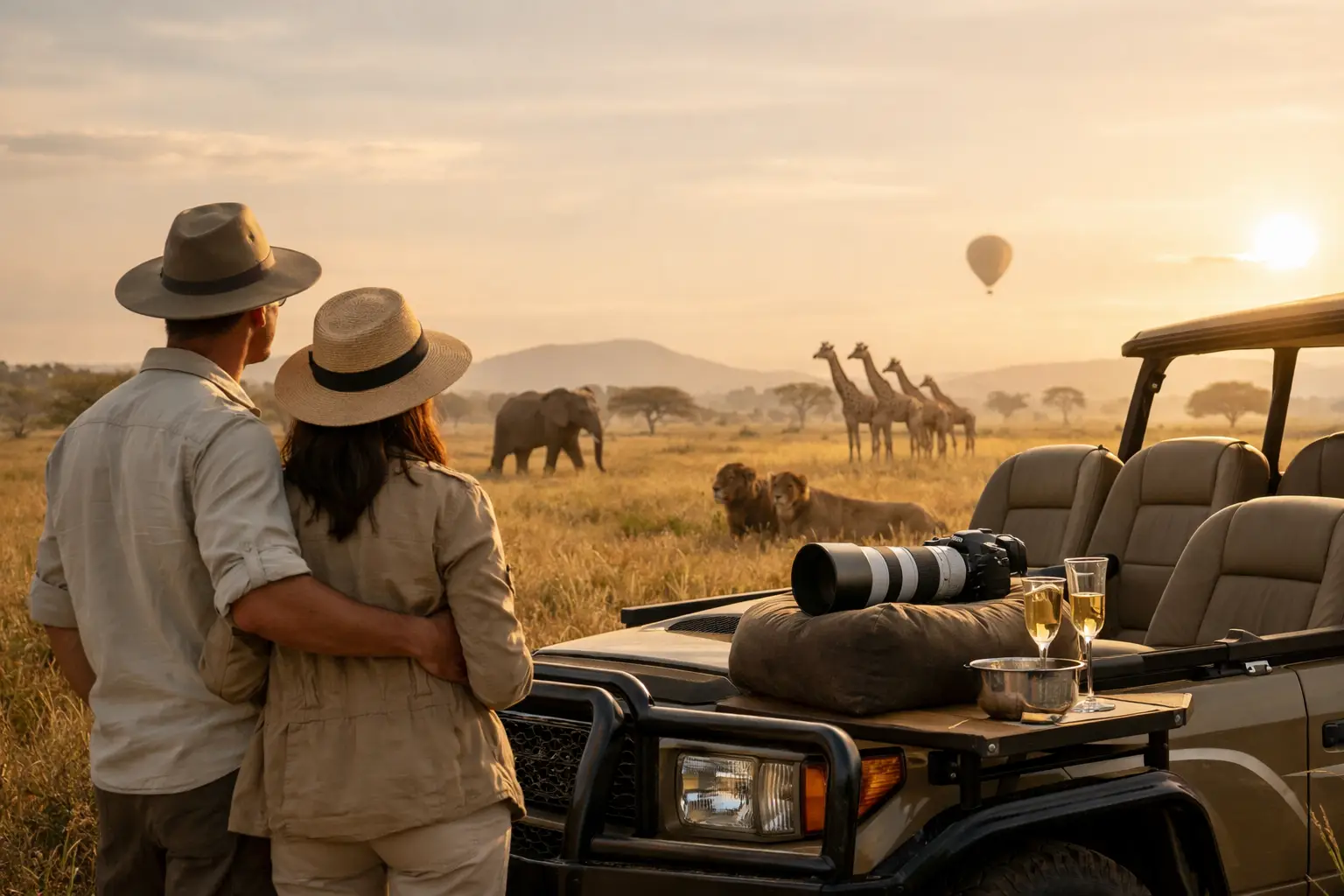
The leopard had been resting in the fork of a fever tree for most of the afternoon. Then, as the light softened over the Serengeti, she rose, stretched, and disappeared into the grass. There was no rush to leave, no fixed schedule pulling you toward the next stop. That freedom to stay with a moment is what separates a tailor made African safari from a standard itinerary.
For well-traveled guests, an African safari is rarely about checking the Big Five off a list. It is an opportunity to be fully present in landscapes that still feel wonderfully untamed, guided by people whose knowledge transforms every sighting into a story. The most memorable journeys are shaped around how you want to experience Africa: unhurried or active, deeply secluded or socially connected, centered on wildlife, culture, conservation, or a thoughtful combination of all three.
What Makes a Tailor Made African Safari Different
A custom safari begins with the traveler, not a preset route. It considers the rhythm you enjoy, the level of privacy you expect, and the experiences that will mean the most when you look back on the journey years from now.
Perhaps you would rather spend four nights in one exceptional private concession than change camps every other day. Perhaps you have always wanted to photograph elephants at eye level, meet a conservation team protecting rhinos, or pair the drama of the Maasai Mara with quiet days on the Indian Ocean coast. Those preferences determine the itinerary.
This approach also allows for better decisions about timing. The Great Migration is extraordinary, but it moves. River crossings in northern Tanzania and Kenya are not guaranteed on a particular date, while the calving season in the southern Serengeti offers an entirely different kind of spectacle. A skilled advisor can help align your priorities with the right region and season rather than promising a single, oversimplified version of safari.
Begin With the Experience You Want to Remember
The best planning conversations often start with a simple question: what do you hope this journey feels like?
Some travelers want sunrise game drives followed by long, leisurely lunches overlooking a waterhole. Others want to be out before dawn with a private guide, tracking wildlife on foot and returning after dark from a night drive. For a second honeymoon or milestone anniversary, a tented suite with a private plunge pool and a candlelit dinner in the bush may be essential. A multigenerational family may place greater value on flexible game-drive schedules, spacious family accommodations, and guides who bring the bush to life for every age.
There is no universally “best” safari. Botswana’s remote delta camps can be ideal for travelers who value silence, water-based exploration, and a strong sense of exclusivity. Kenya may be the right fit for wide-open savannas, rich cultural encounters, and superb family-friendly properties. Tanzania offers remarkable scale, from the Ngorongoro Crater to the Serengeti’s endless plains. South Africa can be particularly appealing for first-time safari guests seeking excellent wildlife viewing, sophisticated lodges, and an easy pairing with Cape Town and the Winelands.
Rwanda and Uganda offer another dimension altogether: the profound, intimate experience of trekking to mountain gorillas through misty forests. It is more physically demanding than a traditional game drive, but for many travelers, the hour spent with a gorilla family becomes the emotional center of the entire journey.
The Right Pace Is a Luxury
One of the most common mistakes in African travel is trying to see too much. Distances are vast, and even flights between camps require time, coordination, and patience. A journey filled with one-night stays may look exciting on paper, yet leave little room to absorb the destination.
In many cases, fewer camps and longer stays create a richer safari. You begin to recognize the calls around your tent at night. Your guide learns your interests. You may follow the same lion pride over several days and see a narrative unfold that a quick visit would miss. Luxury, in this setting, is not only found in beautiful accommodations. It is found in having enough time.
Choosing Camps That Match Your Travel Style
Safari camps are not interchangeable, even when they share a similar level of polish. Some are designed around social energy, with communal dining and stories exchanged around the fire. Others offer extraordinary privacy, with just a handful of suites placed far apart in the landscape. Some are celebrated for design and gastronomy; others for their access to exceptional wildlife areas and deeply experienced guides.
The ideal camp is the one that supports your purpose for traveling. A photographer may benefit from a camp with flexible vehicle policies, expert photographic guides, and the ability to remain at a sighting as light changes. Travelers seeking a more active adventure may prefer walking safaris, canoeing, horseback riding, or mokoro excursions in the Okavango Delta. Those who value cultural immersion might include time with Maasai or Samburu communities through respectful, locally led experiences that go beyond a brief village visit.
Private concessions deserve special consideration. These protected areas, often adjacent to national parks, can permit activities that are restricted inside the parks, such as off-road tracking, night drives, and bush walks. They may also limit the number of vehicles at a sighting. The trade-off is that they can command a higher investment, and the wildlife pattern in any one concession will vary. For many discerning travelers, the privacy and flexibility are worth it.
The Guide Shapes the Safari
A remarkable guide does more than spot animals. They read the landscape. They notice fresh tracks in the dust, distinguish alarm calls, explain the social structure of an elephant herd, and know when silence is more meaningful than commentary.
On a tailor-made journey, matching the guide to your interests can elevate the experience considerably. A passionate birder, aspiring photographer, dedicated conservationist, or traveler who simply wants to understand the ecology of the bush will each benefit from a different guiding style. Private guiding may be especially worthwhile for couples and families who want complete flexibility over when to depart, how long to stay, and what to prioritize each day.
The same principle applies beyond the safari vehicle. A private historian in Cape Town, a chef-led market visit, or a carefully arranged meeting with conservation professionals can create the kind of context that turns a beautiful trip into a meaningful one.
Thoughtful Planning Removes the Friction
Africa rewards preparation. Seasonal conditions, internal flight schedules, baggage restrictions, health considerations, visa requirements, and the practical realities of remote travel all matter. None of these details should diminish the anticipation of the journey, but they should be handled with care.
A well-designed itinerary accounts for the transition points that travelers often overlook. It may include a restorative night after a long international flight before heading to the bush, or a well-placed overnight near an airport to protect against missed connections. It balances the excitement of remote camps with the reassurance of reliable logistics. It also considers what happens if weather changes, a flight is delayed, or a guest needs support while traveling.
This is where concierge-level planning earns its value. The goal is not to make an ambitious journey feel overproduced. It is to make it feel effortless. At Dream Vacations – Matt Boshcka, that means looking beyond reservations to the details that shape comfort, confidence, and the freedom to enjoy the experience fully.
Let Africa Set the Standard, Not a Checklist
A tailor made African safari is an investment in rare encounters: the low rumble of lions before sunrise, a herd of elephants crossing a river in gold afternoon light, the quiet concentration of a tracker following a nearly invisible trail. It is also an investment in perspective. The wilderness has a way of recalibrating what deserves your attention.
Start with the moments you most hope to experience, then allow the right places, guides, and pace to form around them. The journey will be more personal, more comfortable, and far more likely to become one of the stories you return to for the rest of your life.
Leave a Reply