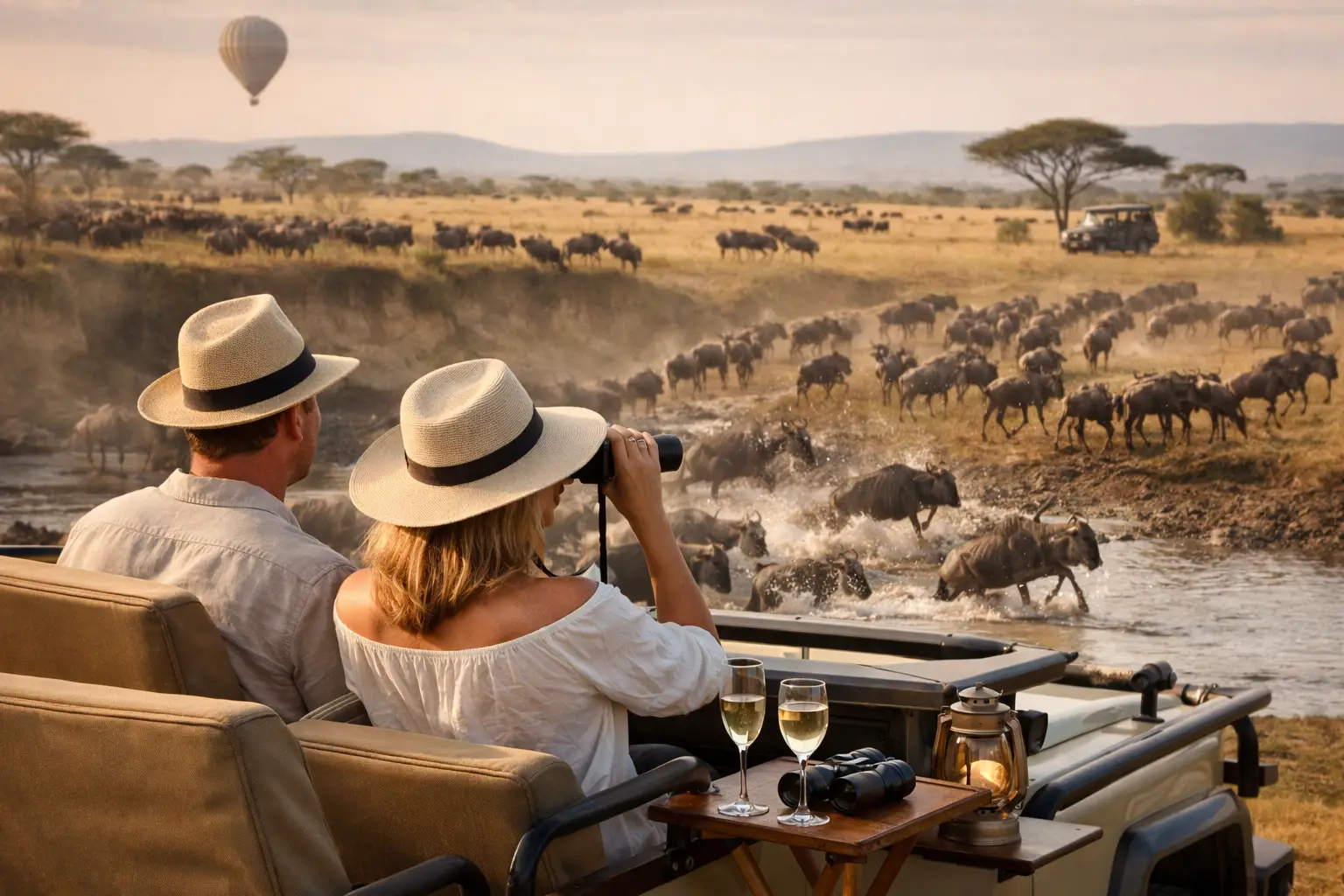
At first, there is only a low, distant rumble across the grasslands. Then the horizon begins to move: thousands of wildebeest, zebras, and gazelles gathering momentum beneath the vast East African sky. A great migration safari guide should do more than identify a season on a calendar. It should help you understand how to be in the right place, at the right pace, for one of nature’s most extraordinary living events.
The Great Migration is not a single crossing or a fixed spectacle that arrives on schedule. It is a year-round movement shaped by rainfall, fresh grazing, river levels, and instinct. For discerning travelers, that unpredictability is part of its power. With thoughtful planning, it can also become the foundation for a deeply personal safari – one that pairs remarkable wildlife encounters with intimate camps, exceptional guiding, and time to absorb the experience rather than rush through it.
What Makes the Great Migration So Extraordinary
More than 1.5 million wildebeest, accompanied by hundreds of thousands of zebras and gazelles, move in a vast annual circuit between Tanzania’s Serengeti and Kenya’s Maasai Mara. Predators follow closely. Lions wait in tall grass, cheetahs scan the open plains, and Nile crocodiles hold their positions in the rivers.
Yet the migration’s emotional impact is not limited to its dramatic moments. A quiet morning watching calves find their footing in the southern Serengeti can be as affecting as a chaotic river crossing. So can sundowners overlooking a herd stretching beyond sight, or a conversation with a gifted guide who can read a fresh leopard track in the dust.
A well-designed safari creates room for both. It respects the unpredictability of wildlife while placing you in regions where the season’s most compelling behavior is likely to unfold.
When to Go on a Great Migration Safari
There is no universally best month. The ideal timing depends on what you hope to witness, how you prefer to travel, and whether you value dramatic action, fewer vehicles, green landscapes, or a particular style of camp.
January through March: Calving Season in the Southern Serengeti
From late January into March, the herds congregate on the nutrient-rich short-grass plains of the southern Serengeti and Ngorongoro Conservation Area. This is calving season, when hundreds of thousands of wildebeest calves are born within a remarkably short period.
The experience is tender, intense, and full of life. Newborn animals draw predators, creating frequent but natural predator-prey encounters. The scenery is often beautifully green after seasonal rains, and the open plains make wildlife viewing especially rewarding. This is an exceptional choice for travelers drawn to wildlife behavior, photography, and the full emotional range of the natural world.
April through June: The Herds Begin Moving North
As grazing changes, the migration moves through the central and western Serengeti. April and May can bring rain, which makes the landscape lush and can reduce the number of visitors. For some travelers, this is a meaningful advantage: quieter sightings, dramatic skies, and a more private feeling on the plains.
The trade-off is that rain can affect road conditions and some camps may close seasonally. By June, the herds are generally advancing toward the western corridor, where the first major river challenges may occur. Flexible travelers who appreciate atmosphere as much as action often find this period especially rewarding.
July through October: River Crossings and the Northern Serengeti
The northern Serengeti and Kenya’s Maasai Mara are most often associated with river crossings. During these months, herds confront the Mara River and other waterways as they continue their search for grass. Crossings can be thrilling, but they are never guaranteed. A herd may gather at the riverbank for hours or even days before deciding to move.
This is high season for good reason. Weather is generally dry, wildlife viewing is excellent, and the migration may produce unforgettable river scenes. It can also be busier, particularly in well-known areas of the Maasai Mara. The right private conservancy, remote northern Serengeti camp, or carefully selected mobile camp can make a substantial difference in the quality and privacy of the experience.
November and December: The Return South
With the short rains, the herds typically begin their journey back toward the southern Serengeti. This transitional period can offer excellent game viewing, fresh green landscapes, and a sense of movement without the peak-season concentration of vehicles. Exact locations vary from year to year, so itineraries should be built with flexibility rather than rigid expectations.
Choosing Tanzania, Kenya, or Both
Tanzania offers scale. The Serengeti is immense, and a longer itinerary can reveal distinct habitats from the southern plains to the remote north. It pairs beautifully with the Ngorongoro Crater, where a full day of wildlife viewing unfolds within an ancient volcanic caldera, as well as Tarangire National Park for elephants and baobab-studded landscapes.
Kenya’s Maasai Mara is compact, wildlife-rich, and particularly compelling from roughly July through October. It also offers access to private conservancies, where vehicle numbers are carefully managed and experiences may include guided walks, night drives, and off-road viewing where permitted. These details can transform a safari from excellent to genuinely exclusive.
For travelers with the time, a cross-border journey can be extraordinary. A Tanzania-focused safari during calving season may be followed by a restorative few days on Zanzibar’s coast. In river-crossing season, combining the northern Serengeti with the Maasai Mara provides geographic flexibility if the herds alter their pattern. The best choice depends on your dates, desired pace, and the kind of moments you most hope to bring home.
Where You Stay Shapes What You See
On safari, camp location matters as much as the camp itself. A beautiful lodge far from current wildlife concentrations may mean long daily drives. A thoughtfully positioned tented camp, by contrast, can place you near the action at first light, when the air is cool, animals are active, and the plains feel entirely your own.
Mobile camps are especially valuable during the migration because they relocate with the herds. They retain the romance of classic safari travel – canvas tents, lantern-lit dinners, and the night sounds of the bush – while offering elevated comforts, attentive service, and exceptional cuisine. Permanent luxury camps may be ideal for travelers who prioritize larger suites, private plunge pools, or a more established sense of place.
Neither approach is inherently better. A journey might combine both: a refined lodge for a few restful nights and an intimate mobile camp positioned near the migration. Private vehicles are also worth considering for couples, families, and serious photographers. They allow your game drives to follow your curiosity, whether that means lingering with a leopard or waiting patiently at a riverbank.
A Great Migration Safari Guide to Better Game Drives
The most memorable sightings rarely come from trying to see everything. Begin early, when golden light settles over the grass and wildlife is most active. Return to camp during the heat of the day for lunch, rest, or time on your veranda, then head out again in the afternoon as the landscape changes character.
Resist the temptation to chase every radio call. An exceptional guide will know when to follow a major event and when to remain with a quieter encounter that is developing naturally. They will also frame what you are seeing in context: the behavior of the herd, the age of a lion cub, the warning calls of birds, and the subtle signs that suggest a hunt may be near.
Bring neutral-colored clothing, a light layer for cool mornings, sun protection, and binoculars, even if you have excellent camera equipment. Most importantly, bring patience. The migration is not a performance. Its most profound moments often happen in the pauses.
The Value of a Bespoke Safari
A Great Migration journey is too significant to treat as a standard itinerary. The quality of guiding, seasonal camp placement, internal flight timing, room category, and even the order of destinations affects how the entire experience feels. For a milestone anniversary, a second honeymoon, or simply a long-held dream, those details deserve careful attention.
At Dream Vacations – Matt Boshcka, a safari can be designed around your preferred level of privacy, your interests in photography or conservation, and the balance you want between adventure and restorative comfort. It may include a private guide, a behind-the-scenes conservation experience, a scenic flight over the Serengeti, or a few unrushed days in a place that speaks to you.
When the last light fades over the plains, the number of animals you checked off a list will matter far less than the feeling of having witnessed a world still governed by wild rhythms. Give the journey enough time, choose the season that suits your imagination, and let the migration meet you on its own terms.
Leave a Reply